This week is Canada’s “Safe Boating Awareness Week”, an annual campaign that raises awareness about enjoying boating while following the best safety practices for all onboard.
You will see many messages from a variety of different boating organizations and it’s important to pay attention to those as when things go wrong on the water there is usually little time to react.

As a seasoned boater I’ve experienced my fair share of scares and know that some days it can feel like your boat has it in for you!
During “Safe Boating Awareness Week” it’s essential to remind ourselves that safety is in the hands of the boat operator and just following a few simple steps will make the voyage a better one.
Here are ten of the main rules I always strive to follow when out on the water:
Numbers 1 AND 2: By now all boaters should know these two yet I still see boaters being charged for failing to comply:
1. Wear a proper fitting Transport Canada approved PFD. This is a no brainer and the boat operator by law must ensure there is one for every person on board and that they fit properly.
2: Never operate any vessel – power, paddle sail, or float – while under the influence of drugs or alcohol.
Number 3: Slow Down!
Speed is a big problem on our small craft routes! There are many passages along the routes that cut through cottage communities where kayakers and canoeists are prominent. Always obey the posted speed and no wake signs – which literally do mean no wake.
When we cruise the Bay we treat it like the roads in Ontario – out in open water crossing the Bay is the “highway” whereas the small craft route is the “school zone” with minimal or no wakes.
Number 4: Sudden Manoeuvres
I was a passenger on a 16’ centre console with a 90 hp engine, we were travelling back from the Western Islands at full speed and I was sitting facing forward on a seat in front of the console when unbeknownst to me, the Captain’s hat flew off and he made a sudden turn to go back without alerting me. The velocity tossed me off my seat and although bruised, luckily my PFD absorbed some of the impact (another great reason to wear them!) and I wasn’t badly hurt but it sure was a shock. Any sudden movements on a vessel can cause issues for the crew so always alert them prior to making any sudden changes in direction.
Number 5 – Never Swim in a Marina!
When I was young and boating with my parents we were once docked at a small pier near Picton with just a few other boats in the area. I went swimming with my father and immediately we felt this awful tingle on our skin – like being stung by multiple thimble jelly fish – but it was caused by faulty wiring of a generator in a boat nearby. Luckily my father recognized the issue and we were able to get out safely but I’ll never forget that feeling.
Electric shock drowning is possible wherever boats and electrical are combined and why “No Swimming” signs are posted in all marinas.
Number 6 – Monitor the Weather!
Stay weather aware: monitor weather forecasts along the way of your journey, understand how to interpret the information and apply it to the area you are boating. And paddlers and floaty lovers – remember it doesn’t take long for wind and a strong current to develop, which can quickly take you far off shore with no way to return.
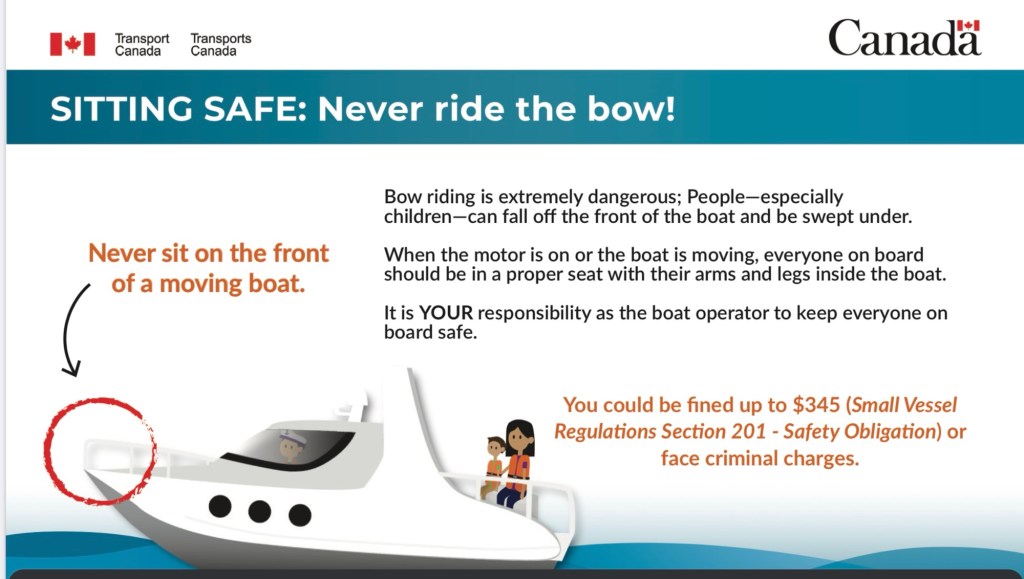
Number 7 – Do not Ride on the Bow
I see this every summer and it amazes me how many parents continue to put their children in such harms way. Never allow passengers to ride on bow with legs hanging over – or anywhere else on the boat. This is illegal and you will be fined should OPP spot you.
Number 8 – Always Connect your Safety Kill Switch Lanyard
If you’ve ever seen a runaway dinghy after the operator has fallen off into the water you will understand why this is so important.
Number 9 – Communication on the Water
When we are out exploring by dinghy we always carry a fully charged submersible VHF radio. In an emergency Channel 16 puts you directly in contact with Canada Coast Guard, plus other nearby boaters may hear you and come to your aid. Cell phone service around Georgian Bay is spotty and calling for help from your phone means a slower response time.
Number 10 – Get Trained!
Operator incompetency and not understanding how to correctly read navigation charts can lead to a lot of problems and confusion on the water so be sure to get trained! Take a boating course, preferably CanBoat, and read your owner’s manual to ensure you are familiar with your vessel’s operation, particularly the safety features.
The Great Lakes Cruising Club offers amazing webinars for its members, from understanding weather to proper anchoring techniques; also the Ports Guide is another valuable resource for Georgian Bay.

Boating can be such an enjoyable hobby when done safely and hopefully my 10 points will make you think about how to minimize the risks on your own vessel.
And I am just a boater helping boaters so be sure to check out what the Canadian experts say and then get ready for a safe and fantastic summer enjoying beautiful Georgian Bay!
Further Resources:
Canada Safe Boating Council:
https://csbc.ca/safe-boating-awareness-week/
Transport Canada Safe Boating Guide:
https://tc.canada.ca/sites/default/files/2024-03/tp_511e.pdf
Canada Power Squadron/CanBoat:
Great Lakes Cruising Club:
 Georgian Bay Beauties: Find Your Wilderness!